Drug name
Last update: Dec 2025Bedaquiline long-acting
Developer(s)
Drug information
long-acting bedaquiline
Sirturo (long-acting version)
Small molecule
Not provided
Long-Acting Bedaquiline is investigated as a single-dose 5mL (TBC) injectable intramuscular formulation for TB Preventive Treatment (TPT). The ongoing phase 1 (final results end of 2026) will allow for the selection of the LAI target dose with predicted pharmacodynamics ar least equivalent to 3HP ( 3 months of weekly isoniazid and rifapentine), the current standard of care. The interim analysis shows no safety concerns. Bedaquiline's properties may allow for this novel regimen among individuals at high risk of developing active TB disease. It is active against both drug-resistant (DR) and drug-sensitive (DS) forms of M. tuberculosis. It has activity in paucibacillary mouse model compared to established oral TPT.
BDQ LAI is currently being investigated in phase 1 study. It will them move to phase 3 TB prevention study, with 3HP as comparator, in a multiyear, multisite, innovative design pivotal study.
BDQ LAI is currently being investigated and is not yet approved by any health authority.
Therapeutic area(s)
- TB
- Post-Exposure Prophylaxis (PEP)
- Prevention
Administration route
Intramuscular
Associated long-acting platforms
unknown, unknown
Use of drug
- Administered by a community health worker
- Administered by a nurse
- Administered by a specialty health worker
- Once
VAS scores used in phase 1 indicated overall moderate pain (median 1.0 (range 0-7) in group receiving 1x5mL IM injection, in the absence of application of ice at injection site.
Dosage
single dose 5mL IM (investigational)
Not provided
BDQ LAI is being investigated in phase 1 at various doses (2x 2.5 mL; 1x 5mL; 2x 5mL)
Not provided
Not provided
Associated technologies
Not provided
Comment & Information
Developer(s)

Johnson & Johnson
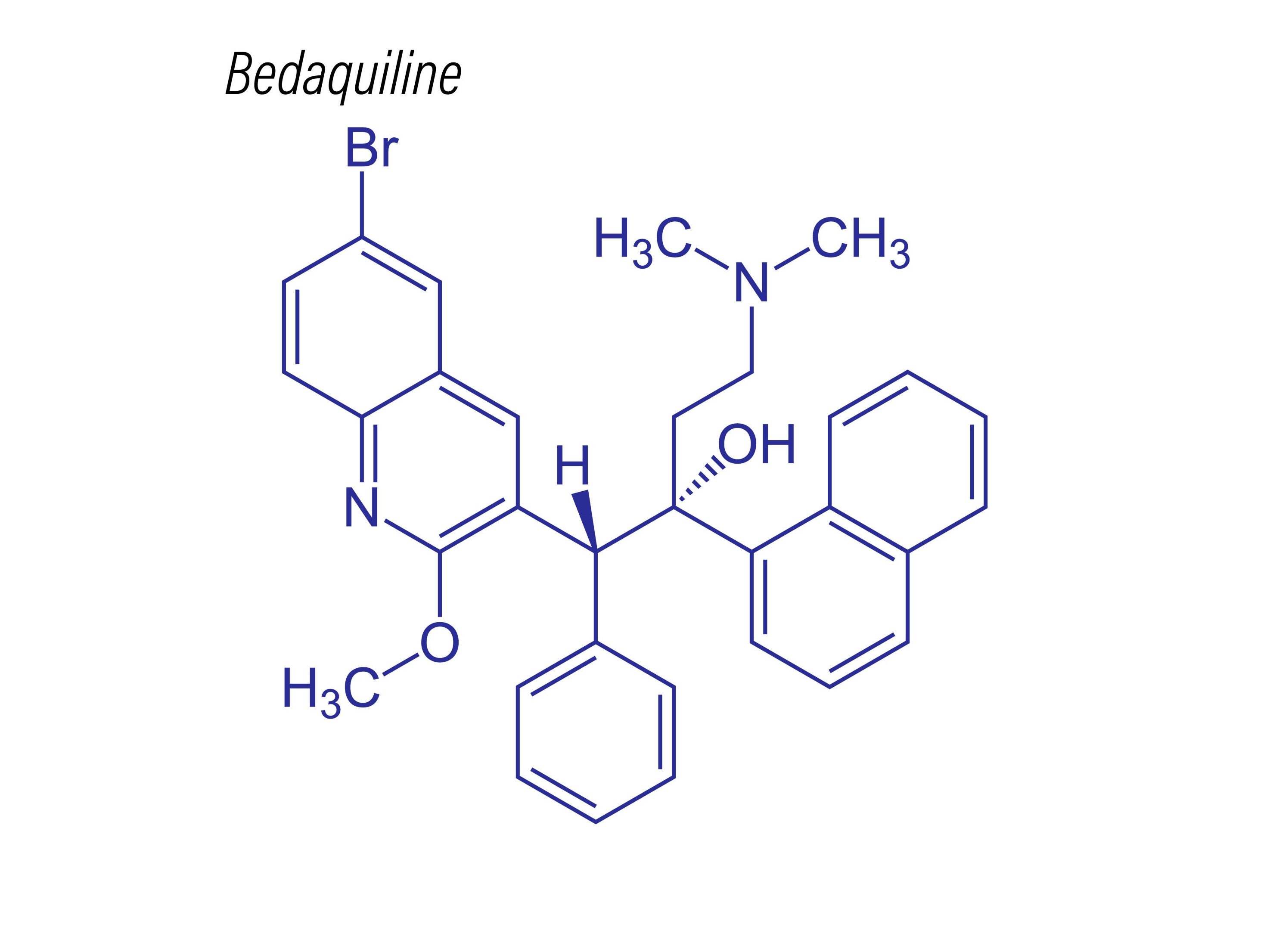
Drug structure
Scale-up and manufacturing prospects
Not provided
Not provided
Not provided
Not provided
Excipients
Not provided
Not provided
Not provided
Delivery device(s)
Not provided
Publications
Bedaquiline: what might the future hold? Shaw, Emily S et al., The Lancet Microbe, Volume 5, Issue 12, 100909
Tuberculosis drug development has stagnated for decades, so the recent availability of bedaquiline is welcome. Bedaquiline-containing regimens, now the first-line therapy recommended by WHO, have transformed the treatment of drug-resistant tuberculosis, offering safer and more effective oral treatment options. However, key obstacles need to be overcome to ensure global access and prevent the rapid development of resistance against this promising class of drugs. In this Personal View, building on an international workshop held in 2023, we evaluate the current evidence and suggest possible ways forward, recognising the tension between increasing use and slowing the rise of resistance. We also discuss problems in accessing bedaquiline-containing regimens, the potential widening of their use beyond drug-resistant tuberculosis, and lessons for utilising new drugs as they are developed.
Rationale: Completion of preventive therapy is a major bottleneck in global tuberculosis control. Long-acting injectable drug formulations would shorten therapy administration and may thereby improve completion rates. Recently, a long-acting formulation of bedaquiline demonstrated antituberculosis activity for up to 12 weeks after injection in a validated mouse model of preventive therapy. Objectives: The objectives of this study were to 1) determine the total duration of activity after an injection of long-acting bedaquiline and 2) evaluate the activity of regimens comprised of long-acting bedaquiline plus short (2-4 wk) oral companion courses of bedaquiline, with or without rifapentine, using the validated mouse model of tuberculosis preventive therapy. Methods: After the establishment of a stable Mycobacterium tuberculosis lung infection in bacillus Calmette-Guérin (BCG)-immunized BALB/c mice, treatment was initiated with 1 of 12 randomly assigned regimens. In addition to positive and negative controls, six regimens included one or two injections of long-acting bedaquiline (alone or with oral bedaquiline with or without rifapentine), and four comparator regimens consisted of oral agents only. Lung bacterial burden was measured monthly for up to 28 weeks. Measurements and Main Results: One injection of long-acting bedaquiline at 160 mg/kg exerted antituberculosis activity for 12 weeks. Compared with the positive control (daily isoniazid-rifapentine for 4 wk), six regimens had equivalent bactericidal activity (including two all-oral comparator regimens), and two regimens had superior sterilizing activity: one injection with 2 weeks of oral bedaquiline and high-dose rifapentine; and two injections with 4 weeks of oral bedaquiline. Conclusions: Long-acting injectable bedaquiline has significant potential for shortening tuberculosis preventive therapy.
A key component of global tuberculosis (TB) control is the treatment of latent TB infection. The use of long-acting technologies to administer TB preventive treatment has the potential to significantly improve the delivery and impact of this important public health intervention. For example, an ideal long-acting treatment could consist of a single dose that could be administered in the clinic (ie, a “1-shot cure” for latent TB). Interest in long-acting formulations for TB preventive therapy has gained considerable traction in recent years. This article presents an overview of the specific considerations and current preclinical advancements relevant for the development of long-acting technologies of TB drugs for treatment of latent infection, including attributes of target product profiles, suitability of drugs for long-acting formulations, ongoing research efforts, and translation to clinical studies.
The potent antituberculosis activity and long half-life of bedaquiline make it an attractive candidate for use in long-acting/extended-release formulations for the treatment of latent tuberculosis infection (LTBI). Our objective was to evaluate a long-acting injectable (LAI) bedaquiline formulation in a validated paucibacillary mouse model of LTBI.
Additional documents
Useful links
Collaborate for development
Consider on a case by case basis, collaborating on developing long acting products with potential significant public health impact, especially for low- and middle-income countries (LMICs), utilising the referred to long-acting technology
Share technical information for match-making assessment
Provide necessary technical information to a potential partner, under confidentiality agreement, to enable preliminary assessment of whether specific medicines of public health importance in LMICs might be compatible with the referred to long-acting technology to achieve a public health benefit
Work with MPP to expand access in LMICs
In the event that a product using the referred to long-acting technology is successfully developed, the technology IP holder(s) will work with the Medicines Patent Pool towards putting in place the most appropriate strategy for timely and affordable access in low and middle-income countries, including through licensing